
Air Quality
Summary
Air quality in Connecticut can worsen due to ground-level ozone, fine particulate matter (PM2.5), and wildfire smoke from other regions. CHPCA advises residents (especially children, older adults, and people with asthma, COPD, or heart disease) to monitor daily air quality and limit exposure on bad air days. The American Medical Association has declared climate change a public health crisis, recognizing that air pollution from climate-related events directly harms patient health.
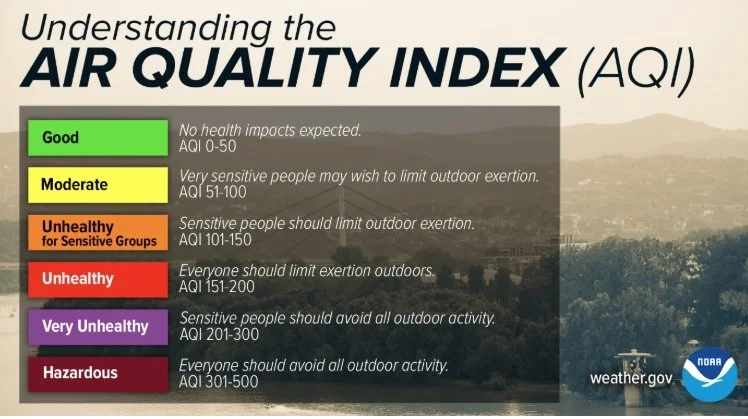
The AQI uses a color-coded scale:
Green (0-50): Good - Safe for everyone
Yellow (51-100): Moderate - Unusually sensitive people should limit prolonged outdoor exertion
Orange (101-150): Unhealthy for Sensitive Groups - Children, older adults, people with heart/lung disease should reduce prolonged outdoor exertion
Red (151-200): Unhealthy - Everyone should reduce prolonged outdoor exertion; sensitive groups should avoid it
Purple (201-300): Very Unhealthy - Everyone should avoid prolonged outdoor exertion
Maroon (301+): Hazardous - Everyone should avoid all outdoor physical activity
PM2.5 drives most smoke-related health risk and that AQI during wildfire smoke is usually PM-driven.
Key Messages
Check the daily Air Quality Index (AQI) at AirNow.gov or through the EPA AIRNow app.
Avoid strenuous outdoor activity when AQI is 'Unhealthy for Sensitive Groups' or higher.
Close windows, run air conditioning on 'recirculate,' and use HEPA air purifiers if available.
Create a 'clean air room' using a portable HEPA air purifier or DIY box-fan filter (tape MERV 13 filter to box fan). https://www.epa.gov/indoor-air-quality-iaq/diy-air-cleaner-reduce-wildfire-smoke-indoors-infographic
Keep rescue inhalers accessible; follow your asthma action plan.
Encourage schools, athletic programs, and outdoor worksites to adjust schedules on poor air days.
Consider N95 or KN95 masks for outdoor activities when AQI is 'Unhealthy' or worse.
People with cardiovascular disease should be especially cautious, as poor air quality increases risk of heart attacks and strokes.
Who is Most at Risk
Children and adolescents (lungs still developing)
Adults 65 years and older
People with asthma, COPD, or other respiratory conditions
People with heart disease or diabetes
Pregnant people
Outdoor workers and athletes
Connecticut-Specific Information
According to the Yale Center on Climate Change and Health's 'Climate Change and Health in Connecticut 2020 Report,' air quality in Connecticut has been affected by increasingly frequent wildfire smoke events from distant fires, as well as local ozone formation during heat events. The Connecticut Department of Public Health Office of Climate and Health provides resources and guidance for municipalities to protect residents during poor air quality events.
When to Seek Medical Care
Worsening asthma symptoms despite using a rescue inhaler
Difficulty breathing or shortness of breath
Chest pain or pressure
Persistent coughing or wheezing
Rapid or irregular heartbeat
Local Resources
CT DEEP: Current Air Quality Reports: https://portal.ct.gov/deep/air/forecasting/aqi/air-quality-index
CT DPH Office of Climate and Health: https://portal.ct.gov/dph/environmental-health/climate-and-health
CT DPH: Asthma Program: https://portal.ct.gov/dph/health-education-management--surveillance/asthma/asthma-program
Yale Center on Climate Change and Health: Connecticut resources and reports: https://ysph.yale.edu/yale-center-on-climate-change-and-health/policy-and-public-health-practice/connecticut/
American Lung Association: State of the Air report for Connecticut: https://www.lung.org/research/sota/city-rankings/states/connecticut
CDC HeatRisk Dashboard: Includes air quality data: https://ephtracking.cdc.gov/Applications/HeatRisk
Your local health department: Contact information available at https://portal.ct.gov/dph/local-health-admin/lha/local-health-administration---site-map?language=en_US